|
|
|
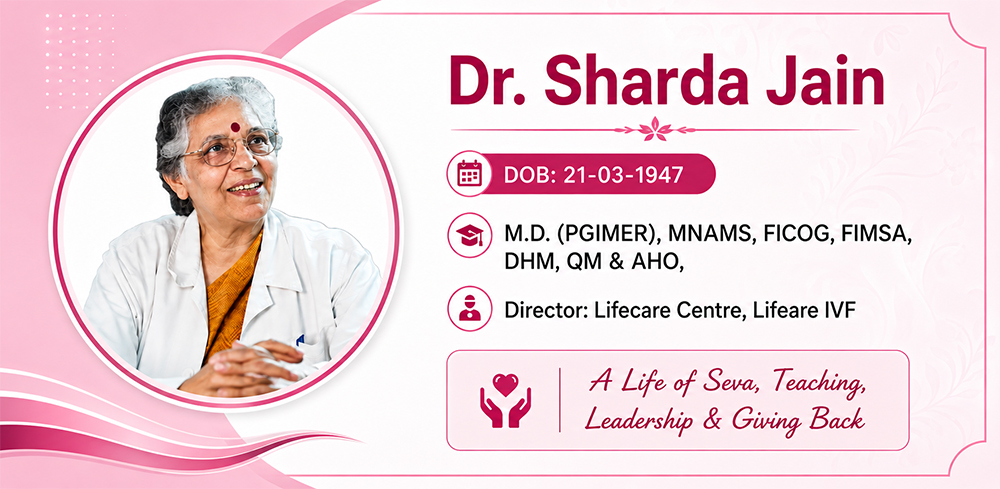
01
A Promise That Shaped a Life
She lost her mother when she was only six. Her father, an engineer, made a remarkable decision: his daughter would become a doctor—and specifically a gynaecologist. That decision became the beginning of a life dedicated not merely to medicine, but to service.
Dr. Sharda Jain entered Lady Hardinge Medical College in 1964 and graduated with Honours and numerous medals. She then joined PGIMER, Chandigarh, for postgraduate training, served there as faculty and subsequently returned to Lady Hardinge Medical College as faculty. Between these two premier institutions, she spent nearly two decades in academic medicine.
Those years taught her that knowledge carries responsibility. She learnt discipline, hard work, clinical excellence, surgical skill and, above all, the value of Seva. She also learnt that knowledge is meant for sharing.
02
Teacher Before Everything
Her years as a faculty member shaped her deepest professional identity: that of a teacher. She believed that a good teacher should make students remember the classroom, remember bedside teaching and remember the surgical skills long after they leave the institution.
Her message was simple: work hard, respect the profession, keep its flag high, and never stop learning. A great doctor needs knowledge; a great surgeon needs skill; but a great mentor must create the next generation.
She had opportunities to move to the USA, but chose to serve the country that had educated her and made her a specialist without asking her to pay for that education. She felt that the best repayment was service to India.
03
A Promise to Her Father
There was another promise she made to her father, and she kept it throughout her professional life:
“Never use your name to rise in the ladder. Never compete for a post in FOGSI. Never apply for Padma Awards or other honours.”
She chose work over lobbying, teaching over self-promotion and institution-building over position-seeking. She never chased awards; recognition came to her through the work itself.
Over the years she has received numerous Lifetime Achievement and Living Legend honours, including the APJ Abdul Kalam Visionary Leadership Award. Yet her greatest satisfaction remains that gynaecologists across India know her work and that generations of doctors have learnt from, worked with and been influenced by her.
She did not use a name to climb a ladder. She built ladders for others.
04
From Academic Medicine to Private Practice
After nearly twenty years within the walls of medical colleges, Dr. Jain entered private practice. She deliberately divided her time: approximately six hours for clinical practice and another six hours for giving back to society.
Her husband, a respected pathologist with expertise in histopathology and cytology, and her daughter, a psychiatrist settled in the USA, have been part of a family deeply rooted in medicine and professional excellence.
Clinical practice gave Dr. Jain the opportunity to serve individual patients. But her larger calling became the strengthening of the profession itself.
05
DMC, MCI & NMC: Ethics and Medico-Legal Service
For nearly two decades, Dr. Jain served as an expert with the Delhi Medical Council, contributing specialist knowledge to professional and medico-legal matters.
Recognising her experience and exemplary work in Obstetrics and Gynaecology, the Ministry of Health & Family Welfare nominated her to the Medical Council of India as one of the members of its Ethics Committee, dealing with important professional and medico-legal matters concerning doctors.
With the transition from MCI to the newly constituted National Medical Commission, she was again entrusted with responsibilities as a senior expert in Obstetrics and Gynaecology, a service she continues to provide.
Her philosophy has remained constant: medicine must be compassionate to the patient, fair to the doctor and uncompromising about professional ethics.
06
National Commission for Women & Advocacy for Women
As Advisor to the National Commission for Women from 2001 to 2003, Dr. Jain came face-to-face with the social, legal and medical realities affecting women.
This experience prompted her to create an educational film for postgraduate training on the scientific and sensitive examination of survivors of sexual assault. The film was remade in 2023 to update its content and incorporate the POCSO Act.
She was also at the forefront of the movement against female foeticide, mobilising volunteers and raising awareness for the dignity and right to life of the girl child.
Her work was never limited to treating disease. She believed that a doctor must also speak when society needs to change.
07
Institutional Delivery, ASHA & Public Health Advocacy
Dr. Jain strongly advocated the movement towards “No Home Delivery” and greater institutional childbirth. This philosophy became an important part of the Government of India’s later emphasis through Janani Suraksha Yojana.
Another public-health idea close to her heart was the concept of a community woman volunteer—initially described as “Basti Sevika”—who would connect women and families with health services. The Ministry of Health and Family Welfare subsequently adopted the concept as ASHA (Accredited Social Health Activist), with the philosophy of community-based service supported through performance-linked incentives.
For Dr. Jain, these were not merely government programmes. They represented a simple principle: take health knowledge to the doorstep of the woman who needs it most.
08
Delhi Gynaecologist Forum: An Institution Without Pomp or Show
In 2000, Dr. Jain founded the Delhi Gynaecologist Forum (DGF). Her model was deliberately different. DGF would not be built around membership fees, grand conferences or heavy dependence on pharmaceutical sponsorship.
Its real currency would be training, training and training.
Over 26 years, DGF has grown to more than 2,500 members and spread across Delhi. Free meetings, free training programmes and free educational resources became its distinctive identity. Annual functions were supported largely by members, and dependence on drug houses was kept minimal.
DGF worked closely with AOGD, which Dr. Jain always regarded as its “big brother”. The aim was not competition, but cooperation, education and professional unity.
The institution became proof that a professional forum can achieve academic strength and social impact without pomp and show.
09
Training Thousands of Gynaecologists
DGF’s flagship programmes have been built around practical competence.
The Cervical Cancer Mukta Bharat programme developed a comprehensive monthly two-day training model focusing on vaccination, screening, colposcopy and treatment of pre-invasive lesions. More than 15,000 gynaecologists have been trained through programmes covering colposcopy and ablative therapies.
Basic Transvaginal Sonography training was designed to ensure that gynaecologists developed practical skills rather than merely acquired certificates.
The Infertility–IVF–ICSI programme covered infertility, IVF, ICSI, embryology and andrology. Around 1,500 gynaecologists have been trained, many of whom went on to establish successful IVF centres of their own.
Critical Care in Obstetrics became another important programme, training hundreds of gynaecologists, particularly faculty from medical colleges.
Dr. Jain’s philosophy was simple: train one doctor well and thousands of women can benefit through that doctor.
10
DGF — Continuing Education Through Every Stage of a Doctor’s Life
Dr. Sharda Jain has always believed that postgraduate training is not the end of learning—it is only the beginning of lifelong learning.
DGF therefore created a continuing academic platform for postgraduate students and young gynaecologists, from both the public and private sectors. The objective was not simply to provide information, but to develop a real knowledge bank of practical clinical skills which need to be updated and upgraded from time to time.
Yearly academic upgradation, monthly case discussions and journal clubs became an important part of this legacy. They provide young doctors an opportunity to discuss difficult cases, learn from experienced teachers and remain abreast of changing evidence and standards of practice.
Importantly, these interactions are not only for the young. They also give senior doctors an opportunity to refresh their own knowledge, revisit current evidence and remain academically connected with the next generation.
11
Mid-Life Gynaecologists — A Special Needs
Dr. Jain also recognised that mid-life gynaecologists have their own professional and personal challenges—and their patients are often passing through the same stage of life.
To address this need, DGF created regular monthly webinars dedicated to mid-life gynaecologists and issues relevant to their patients. These have become extremely popular, providing an interactive platform for professional updating, discussion, reflection and peer support.
This reflects another important aspect of Dr. Jain’s philosophy: a professional organisation must understand the changing needs of its members at different stages of their lives.
Senior Citizens — Continuing to Connect, Create and Contribute
The same philosophy led to the creation of two senior-citizen groups.
One is open to one and all and has become a much-loved platform where members share their creativity, experiences, ideas and happiness. The enthusiasm with which members participate demonstrates that growing older can also mean continuing to connect, create and contribute.
The second group is exclusively for women doctors who have reached their senior-citizen years. For the last three years, monthly meetings have been held to discuss the special professional, social and personal issues faced by senior women doctors.
These meetings are highly interactive and very well attended.
The underlying message is simple: senior doctors should not merely be remembered for what they achieved in the past. They should continue to have a voice, a community, a purpose and an opportunity to share their wisdom.
12
DGF — From Adolescence to Senior YEARS
In many ways, this has become another unique dimension of DGF.
Its activities now address the changing needs of doctors and women through the life cycle:
Adolescents ? Adults below 40 ? Mid-life ? Senior citizens.
Thus, DGF has evolved beyond being simply a professional gynaecological forum. It has become a lifelong academic and social community.
And technology has made this community even larger. Webinars and online meetings have created connectivity between doctors across Delhi and North India, allowing DGF activities, knowledge and fellowship to reach far beyond the physical meeting room.
From a postgraduate attending his or her first academic discussion to a senior doctor sharing decades of wisdom, there is a place for everyone.
Perhaps this is one of the most enduring legacies of Dr. Sharda Jain:
“A doctor should never stop learning, never stop teaching and never stop belonging.”
DGF has therefore become not merely a forum for professional development, but a community for every stage of a doctor’s journey.
13
NIGF, PGDLMS & Continuing Professional Education
The same philosophy expanded beyond Delhi with the North India Gynaecologist Forum (NIGF), which Dr. Jain founded and chaired. Its vision was to spread the culture of education, leadership, skills and service across North India.
She also supported structured certificate programmes such as PGDLMS, Kanoon Ki Pathshala and the Infertility–IVF Pathshala, recognising that modern gynaecologists need not only clinical competence but also knowledge of law, ethics and professional responsibility.
Two national conferences on medico-legal issues in Obstetrics and Gynaecology were also organised with the support of trusted colleagues and friends, while keeping commercial dependence low.
14
Women Health Forum
The Women Health Forum was created by doctors and teachers with a broader purpose: to take women’s health awareness beyond hospitals and professional circles.
Its emphasis is on prevention, awareness, early detection and practical health knowledge. It represents Dr. Jain’s conviction that improving women’s health requires not only specialists, but informed women, families, communities and healthcare workers.
15
Mission NEEv: From Treatment to Prevention
Her public-health philosophy has evolved into Mission NEEv, with a focus on eliminating preventable maternal mortality, preventable stillbirths, neonatal deaths and anaemia.
The approach is practical: recognise red-flag signs, reduce delays and train every level of the healthcare system—from ASHA workers and medical officers to gynaecologists.
Dr. Jain’s inspiration has increasingly come from the successful health models of states such as Kerala and Tamil Nadu. Her aspiration is to help build a healthier, more skilled North India as part of Viksit Bharat.
16
Mission 12: “Mera HB 12 Hai, Aapka Kya?”
Her latest public-awareness movement is Mission 12—“Mera HB 12 Hai, Aapka Kya?”
The trigger was a disturbing discovery during awareness work in Delhi: even among students in Delhi University and leading private schools, only a small proportion knew the haemoglobin cut-off used to define anaemia.
The lesson was clear: awareness must come before behaviour change.
At this stage of her career, Dr. Jain wants to move beyond the operating theatre and take simple, practical health messages to the community—especially to young people and women.
17
A Legacy of Teachers and Leaders
The most enduring contribution of Dr. Sharda Jain may not be measured in meetings, awards or organisations. It is visible in the people she has trained.
Hundreds of gynaecologists influenced by her teaching have gone on to become teachers, department heads, IVF specialists, surgeons, trainers and leaders across Delhi and North India.
This is why she is remembered as a “Teacher of Teachers” and “Leader of Leaders”.
Her contribution is not only to Obstetrics, Gynaecology and Infertility. It is to the profession itself.
18
The Next Chapter: Viksit Bharat
At 79, Dr. Jain is preparing to wind down active surgical practice, but not service.
The next 5–10 years are envisioned as a new chapter: creating awareness for Viksit Bharat, especially a healthier and more skilled North India.
The emphasis will be on simple, practical and affordable measures to prevent avoidable maternal and neonatal deaths, reduce the four delays, recognise danger signs early, save mothers and their children, and strengthen the contribution of healthcare professionals to nation-building.
The surgeon who spent a lifetime saving individual lives now wishes to influence millions through awareness and prevention.
From treating one patient at a time to empowering a nation with knowledge.
19
The Essence of Her Journey
Her journey began with a six-year-old girl who lost her mother and a father who decided that she would become a doctor.
It passed through Lady Hardinge Medical College and PGIMER; through nearly two decades of teaching; through clinical practice; through DMC, MCI and NMC; through the National Commission for Women; through the fight against female foeticide; through public-health advocacy; and through DGF, NIGF and Women Health Forum.
It grew through thousands of doctors trained in cervical cancer, sonography, infertility, IVF, critical care, medico-legal practice and leadership.
It continues through Mission NEEv and Mission 12.
She never asked to be remembered. She tried to make her work worth remembering.
And perhaps the simplest way to describe six decades of her life is:
“I was given knowledge by my country. I spent my life sharing it.”
Her scalpel may rest more often in the years ahead. Her teaching will not. Her mission will not. Her Seva will not.
20
Reaching the Postgraduate and Young Gynaecologist
Dr. Sharda Jain has always believed that completing postgraduate training is not the end of learning—it is the beginning of lifelong learning.
DGF therefore created a continuing academic platform for postgraduate students and young gynaecologists, from both the public and private sectors. The objective was not simply to impart information, but to create a real-time knowledge bank of practical skills that must be refreshed and upgraded continuously.
Yearly academic upgradation, monthly case discussions and journal clubs became an integral part of this legacy. These programmes provided young doctors with an opportunity to learn from experienced teachers, discuss difficult cases and remain connected with changing standards of practice.
At the same time, Dr. Jain believes that such programmes are equally valuable for senior doctors. Teaching is a two-way process: when elders interact with younger colleagues, they too get an opportunity to refresh their own knowledge, revisit current evidence and remain professionally connected.
21
Mid-Life Gynaecologists — A Forgotten but Important Group
Dr. Jain recognised another important reality: mid-life gynaecologists have their own professional and personal challenges—and their patients are often passing through the same stage of life.
To address this need, DGF began regular monthly webinars specifically focusing on issues relevant to mid-life doctors and their patients. These webinars have become extremely popular, providing a platform for discussion, reflection, professional updating and peer support.
It reflects another dimension of her philosophy: a professional organisation must understand the changing needs of its members at different stages of their lives.
22
Growing Older Together — The Senior Citizen Initiative
The same philosophy led to the creation of two distinct senior-citizen platforms.
One is open to everyone, where members freely share creativity, ideas, experiences and joy. It has become a much-loved space where members discover that ageing can be a period of continued participation, friendship and creativity.
The second is exclusively for women doctors who have reached senior-citizen years. For the last three years, monthly meetings have provided a safe and highly interactive forum to discuss the special professional, social and personal challenges of ageing doctors.
These meetings have been consistently well attended, demonstrating that senior doctors do not want to be merely remembered for what they did in the past. They want to remain connected, useful, creative and heard.
23
DGF — From Adolescence to Senior Years
In many ways, this has become another unique legacy of DGF.
Its activities now touch doctors and women across the entire life cycle:
Adolescents ? Adults below 40 ? Mid-life ? Senior citizens.
The organisation has evolved from being merely a gynaecological forum into a lifelong professional and social network.
And geography has ceased to be a barrier. Through webinars and digital academic platforms, DGF’s meetings and educational activities now connect doctors not only across Delhi but increasingly across North India.
This continuity—from the young postgraduate taking the first steps in the profession to the senior doctor sharing wisdom and experience—is perhaps one of the most beautiful expressions of Dr. Sharda Jain’s belief:
“A doctor should never stop learning, never stop teaching and never stop belonging.”
DGF has therefore become not just a forum for professional development, but a community for every stage of a doctor’s journey.
|
|
|
|


